From Point Solutions to Platforms: Why Disconnected AI Is Holding Insurers Back
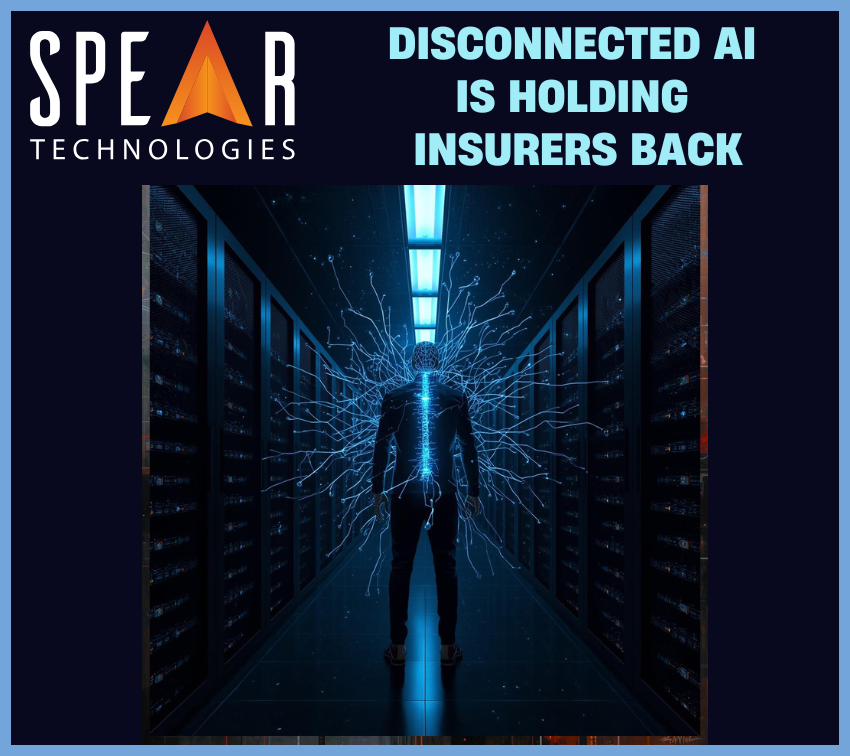
Artificial Intelligence is no longer judged by novelty or isolated wins. The conversation has shifted toward how AI operates across the enterprise, how it supports decision-making at scale, and how multiple AI models work together inside core systems.
Yet many insurance organizations are finding themselves stuck in an uncomfortable middle ground.
They have invested in AI, but results are fragmented. Predictive models live in one system. Generative AI tools exist in another. Automation scripts run in the background. Each delivers value on its own, but together they fall short.
This is the hidden cost of disconnected AI.
While AI adoption has accelerated, too much of it remains point-based rather than platform-driven. As a result, insurers struggle to scale outcomes, govern decisions, and move from insight to action.
For IT leaders, the challenge is no longer whether to adopt AI. It is how to move from tool sprawl to true insurance AI platforms.
The Rise of AI Point Solutions in Insurance
Early AI adoption in insurance followed a predictable path.
Organizations implemented point solutions to solve specific problems:
- Predictive analytics for severity, fraud, or litigation risk
- Generative AI tools for summarization and document drafting
- Robotic process automation for repetitive, rules-based tasks
Each of these tools delivered localized efficiency gains. Many still do. The problem is not that these solutions failed. The problem is that they succeeded in isolation.
Over time, insurers accumulated dozens of AI tools, models, and integrations. Each required data access, governance, security reviews, and ongoing maintenance. Very few were designed to coordinate with one another.
The result is an AI environment that looks powerful on paper but behaves like disconnected islands in practice.
Why Disconnected AI Breaks Down at Scale
For CIOs and CTOs, the limitations of point-based AI become obvious as organizations attempt to scale.
Fragmented Context
Point solutions operate with limited visibility. A predictive model may score a claim, but it does not understand downstream workflows. A generative AI tool may draft correspondence, but it lacks awareness of compliance rules or claim status.
Without shared context, AI insights remain disconnected from action.
Increased Integration Burden
Each AI tool introduces new integrations, data pipelines, and security considerations. Over time, the cost of maintaining these connections outweighs the value of the tools themselves.
This creates technical debt, not transformation.
Governance and Compliance Risk
When AI decisions occur outside core systems, auditability suffers. IT teams struggle to explain how decisions were made, which models were involved, and whether controls were enforced consistently.
In regulated insurance environments, this is not sustainable.
Limited Business Adoption
Disconnected AI tools often require specialized knowledge to operate. Business users cannot easily configure, monitor, or trust outcomes. As a result, AI remains something that happens around the business, not within it.
These challenges are why many insurers feel they have adopted AI, but not truly operationalized it.
From Tools to Platforms: The Shift Underway
Leading insurers are responding by rethinking how AI is delivered. Instead of treating AI as a collection of tools, they are moving toward insurance AI platforms that embed intelligence directly into core systems.
This shift mirrors earlier transformations in insurance technology. Claims systems replaced spreadsheets. Policy platforms replaced fragmented databases. Core systems unified processes that once lived in silos.
AI is now following the same path.
Platform-based AI changes the question from “What can this AI tool do?” to “How does AI operate across the enterprise?”
What Defines an Insurance AI Platform
An insurance AI platform is not defined by a single model or feature. It is defined by how intelligence is integrated, governed, and executed across workflows.
At the center of this model is AI orchestration.
Multi-Model Intelligence Working Together
Modern insurance platforms combine multiple AI approaches:
- Predictive AI to forecast outcomes and risk
- Generative AI to accelerate documentation and communication
- NLP and expert systems to extract meaning and enforce rules
- Agentic AI to coordinate decisions and actions across workflows
Each model plays a distinct role. The platform ensures they work together rather than compete for attention.
Embedded in Core Systems
True AI platforms operate inside claims management and policy administration systems. They have access to real-time data, governed workflows, and system-of-record controls.
This is what allows AI insights to translate into action responsibly.
Governed by Design
Platform-based AI enforces consistency, auditability, and compliance. Decision paths are visible. Escalation thresholds are defined. Human oversight is built in, not bolted on.
For IT leaders, this is the difference between experimentation and enterprise readiness.
The Role of Agentic AI in Platform Thinking
A key enabler of platform-based AI is Agentic AI. Agentic AI functions as the orchestration layer that connects models, systems, and workflows.
Rather than producing a single output, Agentic AI:
- Operates toward defined business goals
- Determines which actions should occur and when
- Coordinates activity across claims, policy, billing, and finance
- Monitors outcomes and adjusts behavior within defined boundaries
This capability is what transforms AI from a passive advisor into an active participant in operations.
Importantly, Agentic AI does not replace Predictive or Generative AI. It depends on them. It ensures insights do not stop at dashboards or documents, but drive coordinated outcomes.
Why Best P&C Core Systems Are Becoming AI Platforms
This evolution is reshaping how insurers evaluate core technology.
The best P&C core systems in 2026 will not be defined by how many AI features they list. They will be defined by how effectively AI operates as part of the platform.
Specifically, leading systems will:
- Embed AI directly into claims and policy workflows
- Support multiple AI models working together
- Enable business users to configure and oversee AI behavior
- Maintain transparency, governance, and auditability
- Scale without multiplying integration complexity
This is why platform thinking matters more than ever for CIOs and CTOs. The architecture decisions made today will determine whether AI becomes a strategic advantage or an operational burden.
What This Means for IT Leaders
As AI investment continues, IT leaders should be asking harder questions:
- Are our AI capabilities coordinated or disconnected?
- Do insights lead directly to action inside core systems?
- Can we govern and explain AI-driven decisions end to end?
- Are we building platforms or managing tools?
Organizations that continue to rely on disconnected AI point solutions will struggle to scale, govern, and evolve.
Those that adopt platform-based AI will gain faster execution, stronger oversight, and more resilient operations.
The Road Ahead
The future of insurance AI is not about adding more tools. It is about building platforms that orchestrate intelligence across the enterprise.
Disconnected AI slows insurers down. Integrated AI platforms move them forward.
As the industry continues to modernize, success will belong to insurers who shift from point solutions to platforms, embed AI directly into their core systems, and treat orchestration as a foundational capability rather than an add-on.
AI is no longer just a feature of modern insurance systems. It is becoming the operating layer that defines how insurance organizations function.
Solutions like SpearClaims™ and SpearPolicy™, delivered through SpearSuite™, reflect this shift by embedding Predictive AI, Generative AI, and Agentic AI directly into claims management and policy administration workflows. This approach enables insurers to move beyond task automation toward coordinated, goal-driven operations while maintaining human oversight through an Accessible AI framework that prioritizes explainability and control.
For insurers evaluating technology investments today, the strategic question is no longer whether to adopt AI, but which core systems are designed to evolve as AI advances.
As organizations assess the best claims management software and best P&C core systems for 2026 and beyond, the focus should move past surface-level AI features and toward platforms built for long-term intelligence, orchestration, and operational resilience.
Schedule a demo of SpearClaims™, SpearPolicy™, and SpearSuite™ to see how built-in, Accessible AI powered by Predictive, Generative, and Agentic AI can help your team work smarter, move faster, and stay in control as the insurance industry evolves.