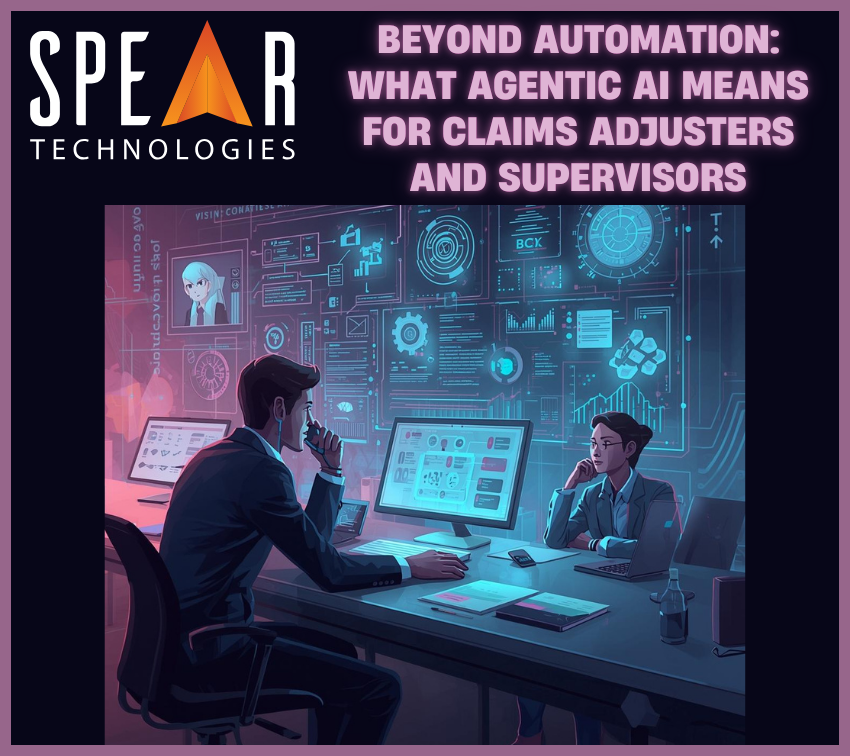
Beyond Automation: What Agentic AI Means for Claims Adjusters and Supervisors
The End Goal is Better Claims Outcomes, Not Just automation for its Own Sake.
For years, claims automation has been framed as a cost-reduction exercise: automate tasks, reduce headcount, move faster. That framing has created understandable resistance among adjusters and supervisors who worry that AI is designed to replace judgment rather than support it.
Agentic AI changes that conversation.
Unlike traditional automation, which follows static rules, agentic AI is designed to work alongside people, handling coordination, prioritization, and execution of routine tasks so claims professionals can focus on decisions that actually require experience and accountability.
The result is not fewer adjusters. It’s better-supported adjusters.
From Task Automation to Intelligent Assistance
Most claims organizations already use some form of automation:
- Rules-based assignment
- OCR for documents
- Workflow triggers in the claims system
These tools help, but they stop short when complexity increases.
Agentic AI goes a step further by:
- Breaking work into tasks dynamically
- Selecting the right tools or data sources
- Executing steps independently
- Knowing when to pause and escalate to a human
This is AI support for claims, not AI decision replacement.
What “Agentic” Actually Means in Claims Operations
In practical terms, an agentic AI system in claims:
- Understands the state of a claim
- Knows what needs to happen next
- Takes action within defined guardrails
- Explains what it did and why
- Flags uncertainty instead of hiding it
For adjusters and supervisors, this feels less like automation and more like having a digital claims coordinator working quietly in the background.
How Agentic AI Supports Claims Adjusters
1. Reducing Administrative Overload
Adjusters spend a disproportionate amount of time on:
- Reviewing documents
- Summarizing notes
- Chasing missing information
- Updating timelines
Agentic AI handles these tasks automatically, keeping the claim organized and current without requiring adjusters to babysit the system.
Impact: More time for investigation, negotiation, and customer communication.
2. Improving Decision Readiness (Not Making Decisions)
Agentic AI does not decide coverage or liability. Instead, it:
- Surfaces relevant policy language
- Highlights inconsistencies in claim data
- Summarizes prior similar claims
- Flags risk factors early
Adjusters remain the decision-makers, but they do so with better context and fewer blind spots.
3. Catching What Humans Miss Under Pressure
High volume environments create risk:
- Missed subrogation opportunities
- Late vendor engagement
- Incomplete documentation
Agentic AI continuously scans for patterns and signals across claims, ensuring nothing falls through the cracks simply because the workload is heavy.
What Agentic AI Means for Claims Supervisors
Supervisors benefit just as much, if not more, from agentic systems.
1. Real-Time Visibility Into Workload and Risk
Instead of static dashboards, supervisors gain:
- Live insight into claim complexity
- Early warnings on stalled or risky claims
- Confidence scores tied to AI-assisted actions
This enables proactive coaching rather than reactive fire drills.
2. Consistency Without Micromanagement
Agentic AI helps standardize:
- Documentation quality
- Workflow adherence
- Escalation timing
Supervisors don’t need to review every claim; only the ones that genuinely require attention.
3. A Safer Path to Automation
Because agentic AI is:
- Observable
- Interruptible
- Auditable
Supervisors maintain control. Every action can be reviewed, explained, and corrected, which is critical for compliance and trust.
What Agentic AI Is Not
To be clear, agentic AI should not:
- Make final liability determinations
- Override policy rules or regulations
- Operate without human escalation paths
When implemented correctly, it reinforces, not weakens, governance.
The New Definition of Claims Adjuster Automation
Claims adjuster automation is no longer about replacing people with systems.
It’s about:
- Removing low-value work
- Supporting better decisions
- Scaling expertise across the organization
- Protecting adjuster capacity and morale
Agentic AI makes this possible by acting as a force multiplier, not a substitute.
Final Takeaway: Augmentation Wins
The future of claims is not human vs. machine.
It’s human expertise, augmented by intelligent systems that know when to act, and when to step aside.
Claims organizations that embrace agentic AI as support, not replacement, will see faster cycle times, better outcomes, and more resilient teams.
That’s what moving beyond automation really means.
Modern claims organizations need AI that is practical, governable, and built for real operations. Proven solutions, not experiments.
Spear Technologies delivers Accessible AI designed to support control, transparency, and scale across modern claims management and enterprise risk platforms. Through SpearClaims™ and SpearSuite™, insurers can implement human-in-the-loop frameworks that enable responsible AI adoption, strengthen risk assessment, and adapt as regulatory, operational, and customer expectations continue to evolve.
Schedule a demo of SpearClaims™ and SpearSuite™ to see how Predictive, Generative, and Agentic AI can help your claims team work smarter, move faster, and stay firmly in control.