How AI Orchestration Is Redefining Modern Claims Management Software
For years, innovation in claims technology focused on automation. Faster workflows. Fewer manual steps. More tasks handled by machines.
That wave delivered real efficiency gains, but it also created a new problem for claims leaders: disconnected automation that is difficult to govern, explain, and scale.
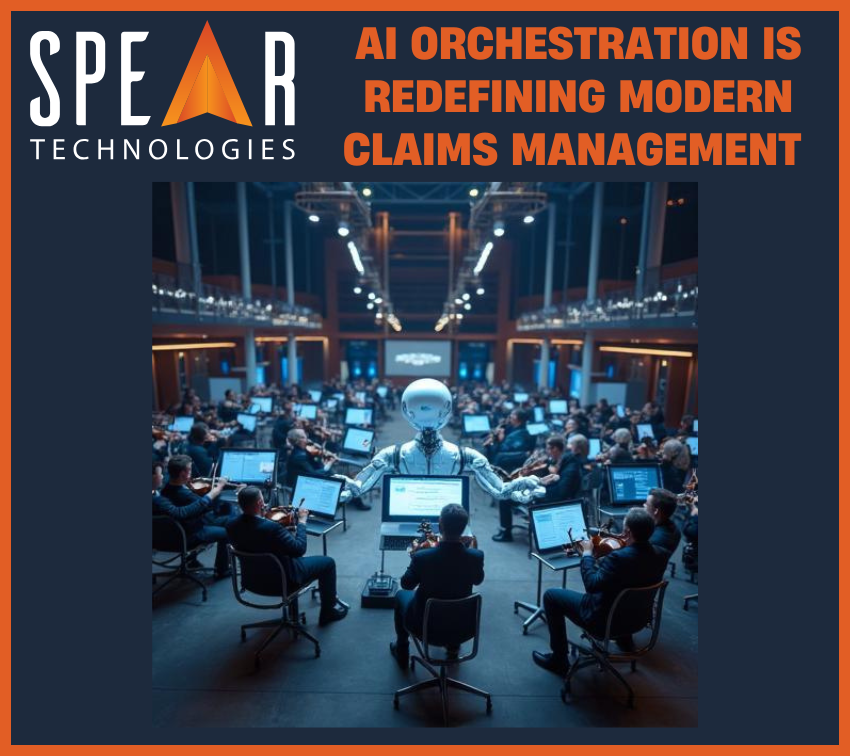
As claims organizations look ahead, the conversation is shifting. The question is no longer how much of the claims process can be automated, but how organizations coordinate, supervise, and align intelligence across the claims lifecycle to drive business outcomes.
This is where AI claims orchestration is redefining what the best claims management software looks like.
Automation Solved Tasks. Orchestration Solves Outcomes.
Traditional claims automation focuses on individual actions:
- Auto-routing a claim
- Estimating damage
- Flagging potential fraud
- Generating correspondence
Each task may work well on its own. When these capabilities operate independently, claims leaders lose visibility into how teams make decisions and achieve outcomes.
AI orchestration changes the model.
Instead of isolated automations, orchestration coordinates multiple AI capabilities, rules engines, and human decisions across the full claims lifecycle. It ensures that intelligence works together, in sequence, and under governance.
For claims executives, this shift directly impacts the outcomes that matter most:
- Cycle time
- Severity control
- Adjuster productivity
- Regulatory defensibility
- Customer trust
What AI Claims Orchestration Really Means
AI orchestration is not a single model or feature; it’s an operating approach.
In orchestrated claims environments:
- AI models are activated based on context, not just availability
- Decisions are explainable and traceable
- Humans remain in the loop at defined control points
- Business rules, compliance requirements, and AI outputs work together inside the core system
This approach treats AI as decision infrastructure, not a collection of tools.
That distinction is becoming a defining characteristic of the best claims management software.
Why Claims Outcomes Depend on Orchestration
Claims executives are ultimately measured on results, not technology adoption. AI orchestration directly influences those results in several critical ways.
1. Faster Resolution Without Losing Control
Orchestrated AI enables straight-through processing where appropriate, while automatically escalating complex or high-risk claims to adjusters.
Instead of choosing between speed and oversight, orchestration allows claims organizations to:
- Accelerate low-complexity claims
- Preserve human judgment where it matters
- Maintain consistent decision logic across the organization
The result is reduced cycle times without sacrificing accountability.
2. More Consistent Severity Management
When AI operates in silos, severity outcomes can vary widely based on which tools are triggered and when.
With orchestration:
- Estimates, fraud indicators, and coverage decisions are evaluated together
- Severity signals are balanced against business rules and historical outcomes
- Adjusters receive guidance that is contextual, not fragmented
This consistency is increasingly important as claims volumes fluctuate, and staffing models evolve.
3. Improved Adjuster Effectiveness, Not Just Efficiency
The goal of modern claims platforms is not to replace adjusters. It is to support better decision-making at scale.
AI claims orchestration provides:
- Prioritized work queues based on risk and complexity
- Decision support that explains recommendations
- Reduced cognitive load from tool switching and manual triage
Adjusters spend less time managing systems and more time resolving claims effectively.
4. Stronger Regulatory and Audit Readiness
Regulators and auditors now look beyond outcomes and ask how organizations make decisions.
Orchestrated AI inside the claims core allows organizations to:
- Trace decisions across models, rules, and human inputs
- Demonstrate consistent application of guidelines
- Explain why a claim was processed a certain way
This level of transparency is difficult to achieve when AI is bolted on through disconnected point solutions.
Why Orchestration Belongs Inside the Core System
Many claims organizations experimented with AI by layering tools around legacy platforms. While this accelerated early adoption, it also introduced risk.
When AI operates outside the core:
- Data synchronization becomes complex
- Decision logic fragments across systems
- Governance and oversight are harder to enforce
AI claims orchestration delivers the greatest value when organizations embed it directly within the claims management platform. As a result, modern claims leaders evaluate platforms not just on features, but on architecture. The best claims management software coordinates intelligence natively rather than managing it externally.
From Automation Metrics to Outcome Metrics
AI orchestration also changes how success is measured. Instead of tracking the number of automated tasks and percentage of straight-through processing, claims leaders can focus on:
- Outcome consistency
- Adjuster decision quality
- Compliance confidence
- Customer experience stability during peak events
The results are executive-level metrics, made achievable by orchestration at scale.
The Future of Insurance Is Coordinated Intelligence
AI in insurance is no longer about isolated wins; it’s about building systems that can manage complexity, uncertainty, and accountability at the same time. As expectations rise from regulators, policyholders, and internal stakeholders, claims organizations need platforms that support intelligence working together, not independently.
That is why AI orchestration is quickly becoming a defining requirement for modern core management software.
Executives who embrace this shift are not just adopting new technology. They are redefining how claims outcomes are achieved, measured, and trusted in an AI-driven future.
Closing Thought
If your organization is exploring artificial intelligence or expanding claims automation, now is the time to define a roadmap that prioritizes coordination, governance, and human oversight, not just speed. As AI becomes embedded in day-to-day claims decisions, success will depend on how well intelligence is orchestrated across systems, teams, and workflows.
Spear Technologies delivers Accessible AI designed for control, transparency, and scale across modern claims management software and enterprise risk platforms. With SpearClaims™ and SpearSuite™, insurers can implement human-in-the-loop frameworks that support responsible AI adoption, strengthen risk assessment, and future-proof their claims management solution as expectations continue to evolve.
Schedule a demo of SpearClaims™, SpearPolicy™, and SpearSuite™ to see how built-in, Accessible AI powered by Predictive, Generative, and Agentic AI can help your team work smarter, move faster, and stay in control as the insurance industry evolves.