
Why Accessible AI Is the Missing Link Between Strategy and Execution
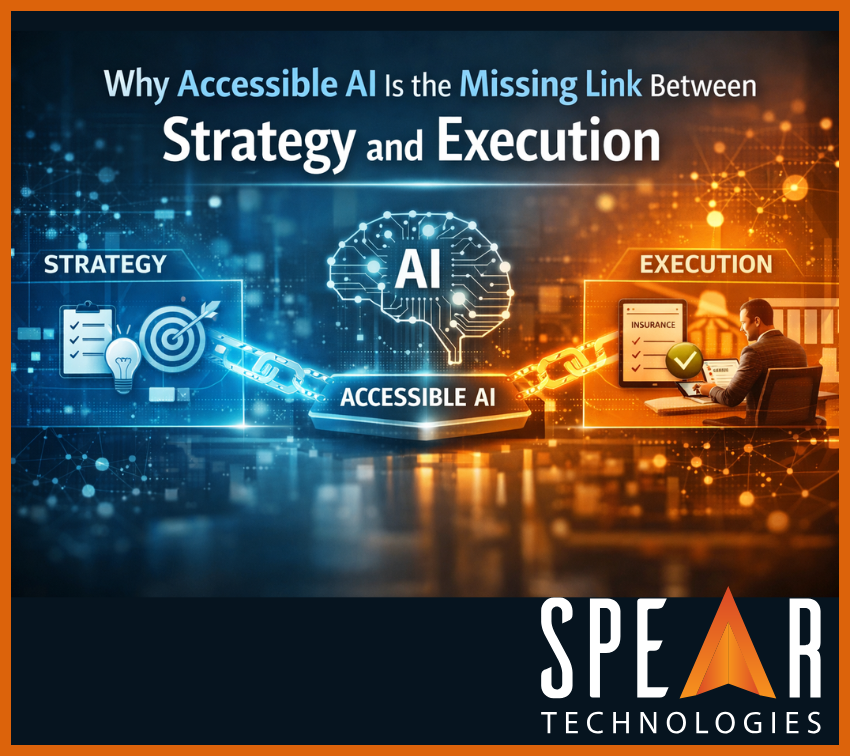
Insurance leaders are no longer asking whether AI matters. Most organizations have already defined their strategy, aligned on priority use cases, and started investing in pilots. Yet progress often stalls.
The problem is not a lack of vision. It is the inability to consistently translate that vision into day-to-day execution. That is where accessible AI becomes critical.
Strategy Is Clear. Execution Is Not.
Across the industry, AI strategies tend to converge around the same goals. Carriers want to improve underwriting accuracy, accelerate claims processing, detect fraud earlier, and deliver better customer experiences.
These priorities are well understood. In many cases, the technology to support them already exists. However, execution tells a different story.
AI initiatives frequently remain stuck in pilot mode. Even when models produce meaningful insights, those insights do not reliably make their way into operational workflows. As a result, the impact stays limited and inconsistent; and it’s this disconnect where most AI programs lose momentum.
The Real Barrier Is Accessibility
The core issue is not model performance. It is usability. Many AI solutions are built with technical users in mind. They require specialized skills, significant data preparation, and ongoing IT involvement just to maintain or adjust them. That creates friction at exactly the point where speed and flexibility matter most.
So even when AI generates valuable output, business teams struggle to act on it. They depend on intermediaries to interpret results, modify logic, or deploy changes. Over time, that dependency slows everything down, and in some cases, it even discourages adoption.
Accessible AI addresses this problem by removing those barriers. It brings AI closer to the people who actually run the business.
What Accessible AI Looks Like in Practice
Accessible AI does not mean dumbing down the technology. It means embedding it into the way work already gets done. Instead of operating as a separate layer, AI becomes part of everyday workflows. Business users can interact with it directly, understand what it is doing, and apply its outputs without needing a technical translation step.
This shift changes how organizations operate. Decisions no longer wait for analysis to move between teams. Adjusters, underwriters, and operations leaders can act in the moment, using AI as a support system rather than a distant capability, and this is where execution starts to improve.
Moving From Insight to Action
One of the most common failure points in AI initiatives is the gap between insight and action. Traditional approaches focus heavily on generating predictions. They produce scores, flags, or recommendations, then rely on humans to figure out what to do next. That extra step introduces delay and inconsistency.
Accessible AI closes that gap. It enables organizations to operationalize insights within the same environment where decisions are made. Instead of handing off outputs, it connects them directly to actions.
For example, when AI identifies a potentially fraudulent claim or highlights missing information, the next step should not require additional interpretation or system changes. It should be immediately clear, embedded, and actionable. When that happens, AI stops being informative and starts being transformative.
Why Business-User AI Tools Change the Equation
Execution happens in operations, not in strategy decks. The people who handle claims, evaluate risk, and manage workflows make hundreds of decisions every day. If they cannot easily use AI, then AI cannot meaningfully influence outcomes.
That is why business-user AI tools matter so much, shifting control closer to the point of execution. Instead of relying on a small group of technical experts, organizations enable a broader set of users to interact with and benefit from AI.
This doesn’t eliminate the role of IT but refines the role they play. IT focuses on governance, data integrity, and scalability, while the business focuses on applying AI to real-world decisions. The result is a more balanced and effective operating model.
The Compounding Impact of Accessibility
Once AI becomes accessible, its impact begins to compound. Faster decisions create faster feedback loops. Those feedback loops improve both the models and the processes around them. Over time, organizations see more consistency, greater efficiency, and better outcomes across the board.
This isn’t about a single breakthrough use case, it’s about sustained operational improvement, which only happens when AI is consistently used, not occasionally referenced.
From AI Strategy to AI Execution
The insurance industry does not lack ideas, investment, or ambition when it comes to AI.
What it lacks, however, is a reliable way to execute.
Accessible AI fills that gap by embedding intelligence directly into everyday work. It removes friction, reduces dependency, and enables faster, more confident decision-making at scale. Turning AI from a strategic initiative into an operational capability.
Final Thought
The organizations that succeed with AI will not necessarily be the ones with the most advanced models, they’ll be the ones that make AI usable. Because in the end, execution is what drives results, and accessible AI is what makes execution possible.
Schedule a demo of SpearPolicy™ and SpearClaims™ to see how accessible, business-user-driven AI can help your organization turn strategy into execution, improve decision making, and embed intelligence directly into everyday operations.