The Future of Insurance Platforms: How Orchestrated AI Is Shaping the Next Generation of Core Systems
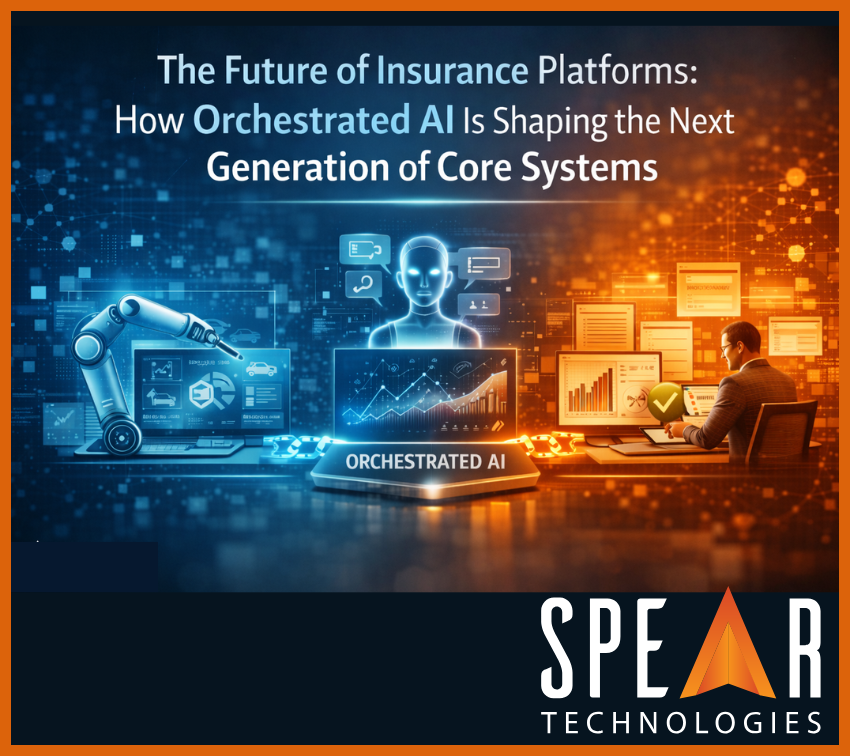
The insurance industry is no longer asking whether AI matters. Instead, the real question has become: How should AI operate at scale inside the enterprise?
As explored in our previous article, Why Accessible AI Is the Missing Link Between Strategy and Execution, the gap between AI ambition and execution remains one of the biggest barriers for insurers today. However, that gap is now closing as insurers drive a fundamental shift in how they design core systems.
Orchestrated AI is driving that shift.
From Systems of Record to Systems of Execution
For decades, the best P&C core systems succeeded because they could store data, enforce rules, and process transactions.
Modern insurance platforms are becoming systems of execution, where they not only record decisions but also initiate, coordinate, and optimize them in real time.
AI orchestration is driving this evolution by moving AI beyond isolated tools and into an operational layer that coordinates workflows across the enterprise.
In practical terms, that means:
- Claims teams no longer just process claims; they dynamically route, prioritize, and escalate them.
- Underwriters no longer simply evaluate risk; they continuously incorporate real-time data and predictive insight into their decisions.
- Teams no longer silo customer interactions; they connect them across policy, billing, and claims.
As a result, the core system is no longer the destination for work. It becomes the engine that drives it.
What Is Orchestrated AI in Insurance?
At its core, orchestrated AI is the coordination of multiple AI models, data sources, and workflows into a unified, goal-driven system. However, that definition alone undersells its impact.
Orchestrated AI introduces a new operating model where:
- AI does not wait for prompts, it initiates next-best actions .
- Workflows are not static, they’re adaptive and context-aware.
- Teams no longer make decisions in isolation; they connect them across systems and teams.
In this model, different types of AI work together:
- Predictive models identify risk, severity, and opportunity
- Generative AI creates summaries, communications, and documentation
- Rules engines and NLP enforce structure and compliance
- Agentic AI coordinates what happens next
This coordination layer transforms AI from a collection of capabilities into a cohesive operational system.
Why Traditional Core Systems Fall Short
Many insurers have already invested in AI. Yet, results often fall short of expectations. The reason is not the quality of the models, it’s the lack of orchestration.
Without orchestration:
- AI outputs remain disconnected from workflows
- Employees must interpret and act on insights manually
- Systems create more fragmentation instead of less
This is why up to 95% of enterprise AI initiatives struggle to deliver meaningful business outcomes: they fail to operationalize AI across the enterprise.
In contrast, orchestrated AI ensures that insights translate directly into action by connecting intelligence to execution.
The Rise of AI-Powered Insurance Platforms
Developers are building the next generation of AI-powered insurance platforms with orchestration at the core, not as an add-on.
These platforms share several defining characteristics:
- Workflow-Centric Architecture: AI is embedded directly into workflows, enabling real-time decision-making at every step.
- Multi-Model Integration: Rather than relying on a single model, platforms coordinate multiple AI capabilities to solve complex problems.
- Event-Driven Design: Actions are triggered by real-time events across systems, eliminating delays caused by batch processing.
- Continuous Learning and Adaptation: AI systems monitor outcomes and refine decisions over time, improving performance without manual intervention.
- Governance and Auditability: Every decision is traceable, explainable, and aligned with regulatory requirements.
This architecture reflects a broader industry shift: AI is no longer treated as a feature—it is becoming the operating model itself.
What This Means for P&C Executives
For C-suite and IT leaders evaluating the best P&C core systems, the criteria are changing rapidly.
It is no longer enough to ask: Does the system handle policy, billing, and claims? Instead, leaders must ask:
- Can the system orchestrate decisions across those functions?
- Can it connect AI directly to operational workflows?
- Can it scale AI without adding complexity or fragmentation?
Because ultimately, the value of AI is not theoretical, it’s operational. It shows up in:
- Faster cycle times
- Reduced manual effort
- Improved decision consistency
- Better customer experiences
And critically, it determines whether a carrier can grow without increasing operational complexity.
The Strategic Imperative: Platform Modernization
Orchestrated AI is not something that can be layered onto legacy systems indefinitely.
While point solutions can deliver incremental gains, long-term value requires a platform designed for:
- Real-time data access
- API-driven integration
- Event-based workflows
- Embedded AI execution
In other words, it requires modernization of the core system itself.
Platform strategy has become a board-level conversation. Insurers are no longer just selecting software, they’re defining their operating model for the next decade.
Looking Ahead: The Autonomous Insurance Enterprise
As orchestrated AI continues to evolve, the trajectory is clear.
Insurance platforms will move toward:
- Autonomous workflows that manage routine decisions end-to-end
- AI-assisted employees focused on complex, high-value work
- Continuous, real-time operations across all business functions
Industry projections suggest that within the next several years, a significant portion of claims processing and underwriting decisions will be automated, enabling near-instant customer experiences.
However, the winners in this transformation will not be those who adopt AI first. They’ll be the ones who orchestrate it best.
Final Thought
The future of insurance platforms is not defined by more features, faster processing, or incremental upgrades. It’s defined by a fundamental shift: From systems that record work
to platforms that coordinate, execute, and optimize it in real time
Orchestrated AI is what makes that shift possible, and for insurers looking to compete in the next generation of the market, it is no longer optional. It is foundational.
Schedule a demo of SpearPolicy™ and SpearClaims™ to see how accessible, business-user-driven AI can help your organization turn strategy into execution, improve decision-making, and embed intelligence directly into everyday operations.