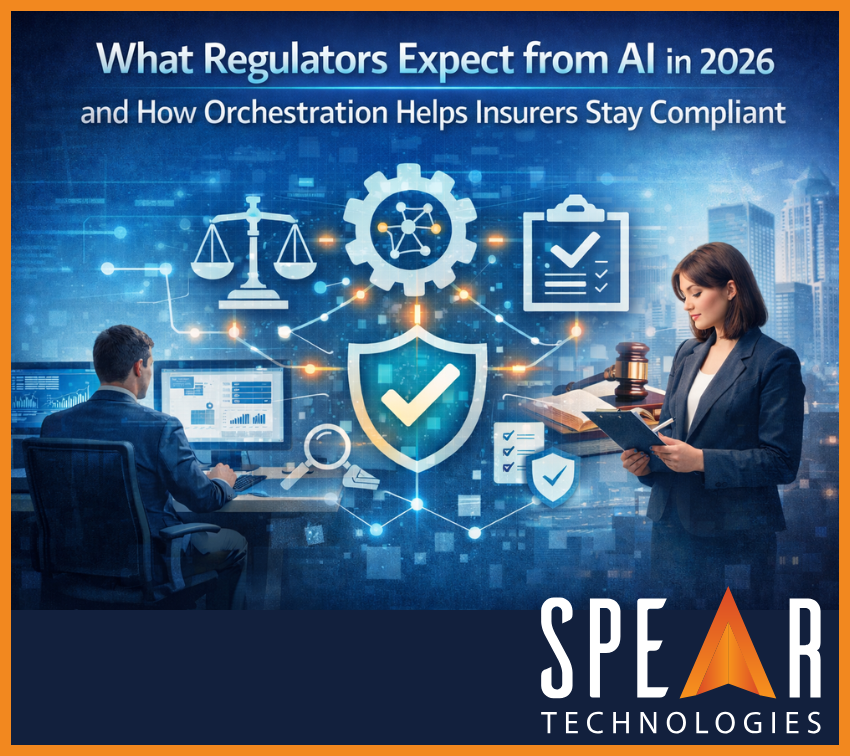
What Regulators Expect from AI in 2026 and How Orchestration Helps Insurers
Artificial intelligence is quickly becoming part of everyday operations across the insurance industry. From underwriting and claims processing to customer service and fraud detection, AI systems are helping insurers improve efficiency and decision-making.
At the same time, regulators are paying close attention.
Across North America, Europe, and other global markets, regulators are making it clear that the use of artificial intelligence must be transparent, explainable, and accountable. Insurers must demonstrate strong AI governance, maintain clear documentation of automated decisions, and ensure human oversight remains in place for critical business processes.
Insurance leaders in compliance, legal, and risk management now focus on how their organizations use AI rather than debating whether to use it. Increasingly, the real question is how to implement AI in a way that satisfies regulators while still allowing the organization to move forward with innovation.
Understanding what regulators expect in 2026 and beyond is the first step toward building a compliant AI strategy.
The Regulatory Focus Areas for AI in Insurance
Although specific requirements vary by jurisdiction, most regulatory frameworks for AI compliance in insurance focus on several common principles.
Transparency and Explainability
Regulators now expect insurers to clearly explain how their systems make automated decisions.. This includes underwriting decisions, claim evaluations, fraud detection outcomes, and pricing recommendations.
Organizations must be able to answer basic questions such as:
- What data influenced the decision
- Which models or algorithms were used
- Why a specific outcome was recommended
This requirement places pressure on insurers to avoid opaque or “black box” decision systems.
Human Oversight and Accountability
Regulators consistently emphasize that AI should assist human decision making rather than replace it entirely.
Insurers must demonstrate that qualified professionals remain responsible for final outcomes in areas such as underwriting approvals, claim settlements, and risk assessment. This approach is often referred to as human in the loop governance.
Data Governance and Model Integrity
AI systems rely heavily on data. Regulators therefore expect insurers to maintain strong controls over the data used to train and operate AI models.
Doing this requires ensuring that data sources are appropriate, that models are tested for bias, and that outputs are regularly monitored for accuracy and fairness.
Auditability and Documentation
One of the most consistent themes in emerging AI regulation is the expectation that insurers maintain detailed documentation of how AI systems operate.
Organizations must be able to show:
- Where AI is used in operational workflows
- How models were trained and validated
- What oversight mechanisms exist
- How decisions can be reconstructed if challenged
In practice, this requirement often becomes a technology challenge. If teams store information related to a claim, underwriting decision, or automated recommendation across multiple systems, audits can become time-consuming and difficult to manage..
Insurers that implement orchestrated workflows often find this process becomes significantly easier. When teams capture operational data, decisions, and supporting documentation within a single platform, auditors can quickly access the information they need without extensive manual investigation.
One insurer recently noted that their auditor specifically highlighted how easy it was to navigate the system and locate the information required for compliance review, eliminating the need to search through multiple disconnected systems.
Why AI Governance Is Becoming a Board-Level Issue
AI governance is no longer a purely technical concern.
Regulators now expect executive leadership and boards of directors to understand how their organizations use artificial intelligence. Insurers must demonstrate that governance frameworks exist to monitor risk, maintain accountability, and prevent unintended consequences.
For many organizations, the difficulty is not simply regulatory interpretation. It is operational complexity.
AI systems are often deployed across multiple departments, vendors, and technology platforms. Without a unified structure, oversight becomes fragmented and difficult to manage.
This is where AI orchestration becomes essential.
How AI Orchestration Strengthens Compliance
AI orchestration provides a structured framework for how AI systems operate within insurance workflows.
Rather than allowing individual AI tools to function independently across different departments, orchestration coordinates how models interact with data, systems, and human decision makers.
This structure creates several compliance advantages.
Clear Workflow Governance
Orchestrated AI environments allow insurers to define exactly where automation occurs within a workflow and where teams conduct human review.
For example, an AI model may assist with claim document analysis, but a claims professional remains responsible for validating the recommendation before final approval.
This approach aligns directly with regulatory expectations around human oversight.
Consistent Decision Documentation
AI operating within orchestrated workflows records and tracks every step in the decision process.
This includes the inputs used, the recommendations generated, and the human actions taken afterward.
Such documentation helps insurers demonstrate compliance with regulatory expectations for transparency and auditability.
Centralized Model Management
Orchestration platforms allow insurers to manage multiple AI models within a single operational framework.
This approach gives insurers greater visibility across underwriting, claims, fraud detection, and other areas where AI operates. Compliance teams can clearly see where automation exists and how systems generate decisions.
Controlled Automation Expansion
One of the greatest regulatory risks occurs when AI adoption expands quickly without consistent governance.
Orchestration allows insurers to scale automation in a controlled manner. Therefore, insurers can introduce each new AI capability within a defined framework that preserves oversight, transparency, and accountability.
Preparing for the Next Phase of Insurance AI Regulation
The regulatory environment for AI will continue to evolve over the coming years. Governments and insurance regulators are actively studying how artificial intelligence affects risk, fairness, and consumer protection.
Insurers that approach AI adoption without a structured governance model may find themselves struggling to meet future compliance requirements.
On the other hand, organizations that implement orchestrated AI frameworks can demonstrate that innovation and responsible oversight can exist together.
By building transparency, human oversight, and clear documentation directly into operational workflows, insurers position themselves to meet regulatory expectations while still benefiting from the efficiency and intelligence that AI can provide.
The Path Forward for AI Governance in Insurance
Artificial intelligence will play an increasingly central role in how insurers operate, compete, and serve policyholders. Regulators understand this. Their goal is not to prevent innovation but to ensure insurers implement it responsibly.
For insurance executives in compliance, legal, and risk functions, the most effective strategy is not to delay AI adoption. It is to ensure that the technology operates within a structured, transparent, and accountable environment.
AI orchestration offers a practical path forward by combining automation with governance, oversight, and operational control.
Organizations that invest in this approach today will better meet the regulatory expectations of 2026 and beyond.
Intelligent Orchestration in the Core Insurance Platform
Spear Technologies delivers Accessible AI designed to support orchestration, transparency, and operational control across modern core insurance platforms, including claims, policy administration, billing, and agent and customer portals. Through SpearPolicy™ and SpearClaims™, insurers can implement orchestrated, human in the loop workflows that help maintain regulatory compliance while improving operational efficiency.
By coordinating how predictive, generative, and agentic AI operate within structured workflows, insurers gain greater visibility into automated decisions, stronger governance over model behavior, and clearer documentation for audit and regulatory review. This approach allows organizations to benefit from AI while preserving the oversight and accountability regulators expect.
For insurers evaluating how claims management and policy administration should operate in an AI enabled environment in 2026 and beyond, the focus should move beyond surface level AI features and toward platforms designed for long term governance, transparency, and operational resilience.
Schedule a demo of SpearPolicy™ and SpearClaims™ to see how orchestrated AI can help your organization improve decision-making, strengthen compliance oversight, and maintain control as AI adoption across the insurance industry continues to expand.