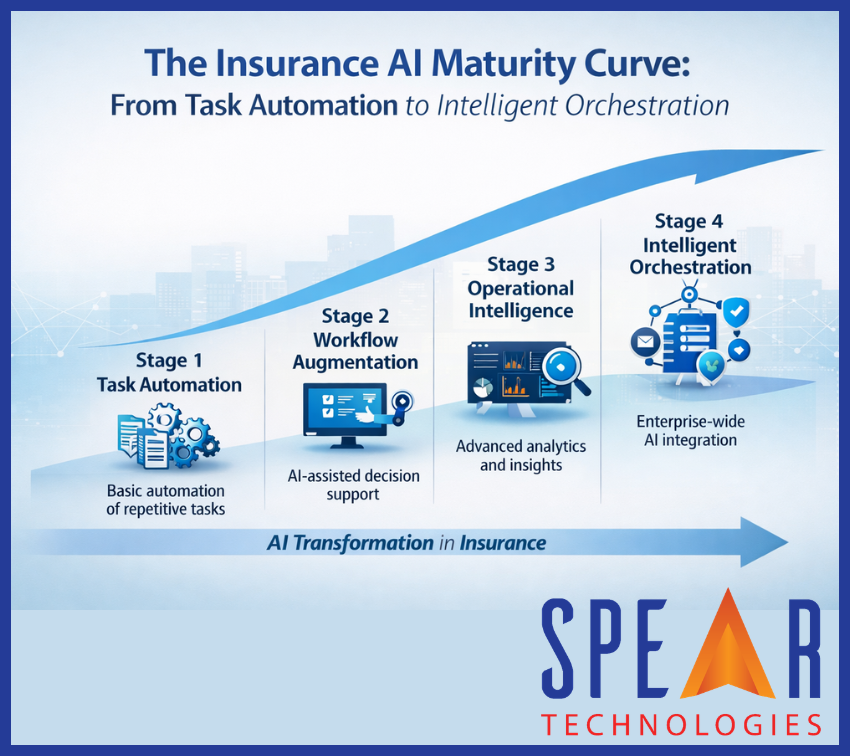
The Insurance AI Maturity Curve: From Task Automation to Intelligent Orchestration
Artificial intelligence has moved quickly from experimentation to strategic priority in the insurance industry. Many insurers are now investing in AI to improve underwriting, claims processing, customer experience, and operational efficiency. However, while interest in AI is widespread, levels of maturity vary significantly across organizations.
Some insurers are still exploring small automation projects. Others are beginning to embed AI across core systems and business workflows. A smaller group is building fully integrated AI ecosystems that drive enterprise-wide decision making.
Understanding where your organization currently sits on the insurance AI maturity model is critical to planning the next phase of AI transformation in insurance. The most successful insurers view AI adoption as a progression that moves from simple task automation to fully orchestrated intelligence across the enterprise.
This article introduces a practical framework for evaluating AI maturity and identifying the next logical step in your journey.
Why AI Maturity Matters in Insurance
Artificial intelligence initiatives often begin with enthusiasm but stall when organizations lack a clear roadmap. Many insurers launch isolated projects that deliver incremental improvements but fail to produce meaningful enterprise impact.
Common challenges include:
- Fragmented AI initiatives across departments
- Limited integration with core policy, billing, and claims systems
- Data silos that restrict model performance
- Lack of governance and operational oversight
Without a structured maturity framework, organizations risk investing in disconnected tools rather than building a scalable AI foundation.
The insurance AI maturity model provides a structured way to evaluate progress and ensure that technology investments support long-term transformation.
The Insurance AI Maturity Curve
Artificial intelligence initiatives often begin with enthusiasm but stall when organizations lack a clear roadmap. Many insurers launch isolated projects that deliver incremental improvements but fail to produce meaningful enterprise impact.
Common challenges include:
- Fragmented AI initiatives across departments
- Limited integration with core policy, billing, and claims systems
- Data silos that restrict model performance
- Lack of governance and operational oversight
Without a structured maturity framework, organizations risk investing in disconnected tools rather than building a scalable AI foundation.
The insurance AI maturity model provides a structured way to evaluate progress and ensure that technology investments support long-term transformation.
The Insurance AI Maturity Curve
AI maturity in insurance typically progresses through four stages. Each stage builds on the previous one and introduces greater operational impact.
Stage 1: Task Automation
The first stage of AI adoption focuses on automating repetitive tasks that previously required manual effort.
Common examples include:
- Document classification and routing
- Claims note summarization
- Data extraction from forms and correspondence
- Email triage and document assignment
These use cases are often implemented as standalone tools or pilot projects. The primary goal is operational efficiency and cost reduction.
While this stage delivers measurable productivity gains, the impact is typically limited to individual workflows.
Key Characteristics
- Isolated AI tools
- Department-level implementation
- Limited integration with core systems
Executive Question
Are AI initiatives primarily focused on automating individual tasks rather than improving end-to-end processes?
Stage 2: Workflow Augmentation
At this stage, AI moves beyond task automation and begins supporting decision making within operational workflows.
Examples include:
- AI-assisted underwriting recommendations
- Claims triage and severity prediction
- Fraud detection models
- Automated claim assignment
Rather than replacing human expertise, AI augments adjusters, underwriters, and operations teams with insights that improve speed and consistency.
This stage represents a significant step forward because AI becomes embedded within daily business processes.
Key Characteristics
- AI embedded within operational workflows
- Decision support capabilities
- Increased operational speed and accuracy
Executive Question
Is AI actively assisting employees in making better decisions, or is it still limited to automating basic tasks?
Stage 3: Operational Intelligence
In the third stage, AI begins to influence operational strategy across multiple departments.
Organizations at this level use AI to analyze patterns across underwriting, claims, and customer data to guide business decisions.
Examples include:
- Predictive loss modeling
- Customer churn prediction
- Risk scoring across portfolios
- Claims trend analysis
AI systems begin generating insights that inform management decisions rather than simply assisting frontline staff.
This stage marks the transition from tactical automation to strategic intelligence.
Key Characteristics
- Enterprise-level analytics and predictions
- Cross-department insights
- AI influencing business strategy
Executive Question
Is AI helping leadership teams anticipate trends and risks across the organization?
Stage 4: Intelligent Orchestration
The final stage represents the most advanced level of AI transformation in insurance.
In this model, AI capabilities are orchestrated across core systems and operational workflows. Policy, billing, claims, and customer data work together within a unified intelligence layer.
Examples include:
- Automated claims workflows that dynamically adjust based on claim complexity
- AI-driven risk evaluation across underwriting and claims data
- Intelligent customer engagement triggered by predictive insights
- Real-time operational optimization
AI becomes the connective tissue that coordinates decisions across systems and departments.
Rather than supporting individual functions, AI orchestrates the entire insurance operation.
Key Characteristics
- AI integrated across policy, billing, and claims systems
- Cross-system automation and intelligence
- Enterprise-wide decision orchestration
Executive Question
Is AI coordinating workflows and decisions across the enterprise?
A Simple Self-Assessment for Insurance Leaders
Executives evaluating their organization’s insurance AI maturity model should consider three core questions:
- Are our AI initiatives isolated experiments or integrated capabilities?
- Are we using AI to automate tasks or to improve decisions across workflows?
- Are our systems connected in a way that allows AI to orchestrate operations across the enterprise?
If most AI initiatives remain isolated within individual departments, the organization is likely in the early stages of maturity.
When AI is embedded within workflows but not yet integrated across systems, the organization may be in the augmentation stage.
However, if AI capabilities are connected across policy, billing, and claims platforms, the organization may be approaching intelligent orchestration.
Moving Forward: Building a Roadmap for AI Transformation
The most successful insurers approach AI transformation in insurance as a strategic journey rather than a single technology deployment.
The progression typically follows three steps:
- Identify high value automation opportunities to generate early operational wins.
- Embed AI within workflows to improve decisions and operational speed.
- Integrate AI capabilities across core systems to enable enterprise-wide intelligence.
Organizations that follow this path are better positioned to unlock the full value of AI.
The Future of Insurance AI
Artificial intelligence is rapidly becoming a foundational capability for insurers seeking to remain competitive.
Companies that remain in the early stages of automation risk falling behind as competitors adopt more advanced AI strategies. Those that progress toward intelligent orchestration will gain significant advantages in operational efficiency, risk management, and customer experience.
Understanding your current position on the insurance AI maturity curve is the first step toward building a roadmap for meaningful transformation.
The insurers that succeed will not simply deploy AI tools. They will orchestrate intelligence across the entire enterprise.
Bringing Intelligent Orchestration to the Core Insurance Platform
Spear Technologies delivers Accessible AI designed to support orchestration, transparency, and operational control across modern core insurance platforms, including claims, policy and billing, and agent and customer portals. Through SpearPolicy™ and SpearClaims™, insurers can implement orchestrated, human in the loop workflows that strengthen underwriting discipline while enabling faster, more consistent decision making.
For insurers evaluating how claims management and policy administration should operate in an AI enabled environment in 2026 and beyond, the focus should move beyond surface level AI features and toward platforms built for long term intelligence, governance, and operational resilience.
Schedule a demo of SpearPolicy™ and SpearClaims™ to see how predictive, generative, and agentic AI can help your organization move faster, maintain consistency, and remain firmly in control as the industry evolves.