Breaking the Silos: How Orchestrated AI Connects Claims, Policy, and Billing
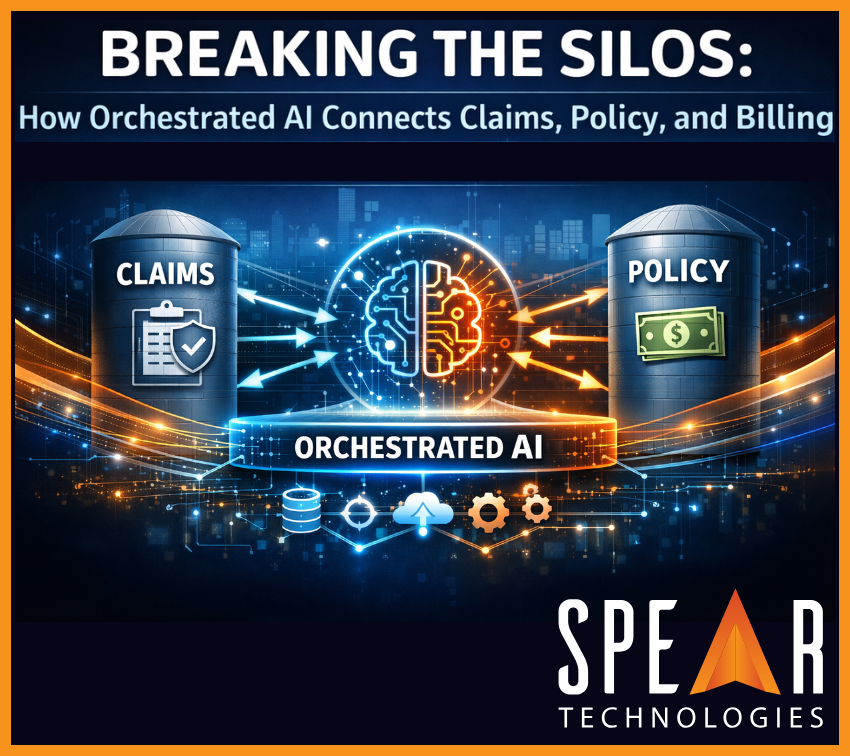
Insurance organizations rarely struggle because of a lack of technology. More often, they struggle because technology operates in silos.
Claims, policy, and billing systems typically evolve independently as each department optimizes its own workflows, metrics, and tools. As a result, insurers create fragmented operations that limit visibility, slow decision making, and increase operating effort.
However, that model no longer scales.
As insurers modernize their core environments, orchestrated AI is emerging as the connective layer that enables insurance core systems integration and supports true end-to-end insurance platforms.
The Cost of Siloed Core Systems
When claims, policy, and billing operate as separate systems, organizations experience common challenges:
- Data moves slowly and often requires manual reconciliation
- Decisions depend on incomplete or outdated information
- Operational handoffs increase cycle time and error rates
- Technology changes in one system disrupt workflows in others
Although each system may perform well independently, the enterprise pays the price for lack of coordination.
For COOs and CIOs, these silos directly impact efficiency, scalability, and customer experience.
Why Point Integrations Are No Longer Enough
Many insurers attempt to address silos through point integrations or custom interfaces. While these connections move data from one system to another, they do not manage how workflows across the enterprise.
As a result:
- Systems exchange information, but processes remain disconnected
- Rules execute in isolation rather than in context
- Exceptions require manual coordination across teams
In contrast, orchestrated AI focuses on process coordination, not just data movement.
What Orchestrated AI Means at the Enterprise Level
Orchestrated AI operates above individual systems. It actively coordinates how claims, policy, and billing processes interact, adapt, and respond to real time conditions.
Instead of asking each system to make isolated decisions, orchestration enables the enterprise to:
- Evaluate context across claims, policy, and billing data
- Determine the next best action based on enterprise goals
- Route work dynamically across teams and systems
- Maintain governance and auditability throughout the process
As a result, insurers move closer to true end-to-end insurance platforms.
Connecting Claims, Policy, and Billing Through Orchestration
To understand the impact, consider how orchestrated AI connects core functions.
Claims and Policy Alignment
When AI orchestrates claims and policy workflows together:
- Coverage validation occurs in real time
- Policy changes reflect immediately in claims decisions
- Adjusters and underwriters operate from the same data context
This alignment reduces leakage, improves accuracy, and accelerates resolution.
Policy and Billing Coordination
With orchestration in place:
- Billing status informs policy actions automatically
- Payment exceptions trigger policy workflows without manual review
- Renewals and endorsements align with billing outcomes
As a result, insurers reduce friction for customers and internal teams.
Claims and Billing Visibility
Orchestrated AI also connects claims and billing by:
- Linking payments, recoveries, and reserves
- Providing real time financial visibility
- Supporting accurate forecasting and reporting
This level of integration strengthens both operational control and financial management.
Why This Matters to COOs
For COOs, orchestrated AI directly supports operational performance. By connecting claims, policy, and billing workflows, organizations can:
- Reduce handoffs and manual coordination
- Shorten cycle times across departments
- Scale operations without linear increases in staff
- Improve consistency and service quality
Most importantly, orchestration enables operations teams to manage processes at the enterprise level rather than department by department.
Why This Matters to CIOs
For CIOs, orchestration changes how technology delivers value. Instead of maintaining brittle integrations and custom workflows, CIOs can:
- Standardize process coordination across systems
- Embed AI directly into core workflows
- Simplify architecture while increasing capability
- Support faster change without disrupting operations
This approach turns core systems into a flexible foundation for long term innovation.
Orchestration Requires the Right Core Platform
Orchestrated AI does not succeed when layered onto disconnected systems. To enable insurance core systems integration at scale, platforms must provide:
- Unified access to claims, policy, and billing data
- Embedded AI capabilities rather than external add-ons
- Workflow orchestration across functions and teams
- Configurability that supports business and IT collaboration
Without these foundations, orchestration remains theoretical.
Moving Toward True End to End Insurance Platforms
The insurance industry is moving beyond departmental optimization.
As expectations rise from regulators, customers, and internal stakeholders, insurers must operate as connected enterprises. Orchestrated AI makes that possible by breaking down silos and coordinating work across the organization.
For COOs and CIOs, the strategic question is no longer whether systems can integrate. Instead, the question is whether your core platform can orchestrate claims, policy, and billing as a single, intelligent operation. That capability defines the next generation of end-to-end insurance platforms.
Spear Technologies delivers Accessible AI designed to support orchestration, transparency, and control across modern core insurance platforms, including claims, policy & billing, and agent & user portals. Through SpearPolicy™ and SpearSuite™, insurers can implement orchestrated, human in the loop workflows that strengthen underwriting discipline while enabling real time decision making.
If your organization is evaluating how claims management and policy administration should operate in an orchestrated AI environment in 2026 and beyond, now is the time to look beyond surface level AI features and focus on platforms built for long term intelligence and operational resilience.
Schedule a demo of SpearPolicy™ and SpearClaims™ to see how Predictive, Generative, and Agentic AI can help your organization move faster, stay consistent, and remain firmly in control as the industry evolves.