Workflow Automation for Claims Executives: From Operational Friction to Coordinated Execution
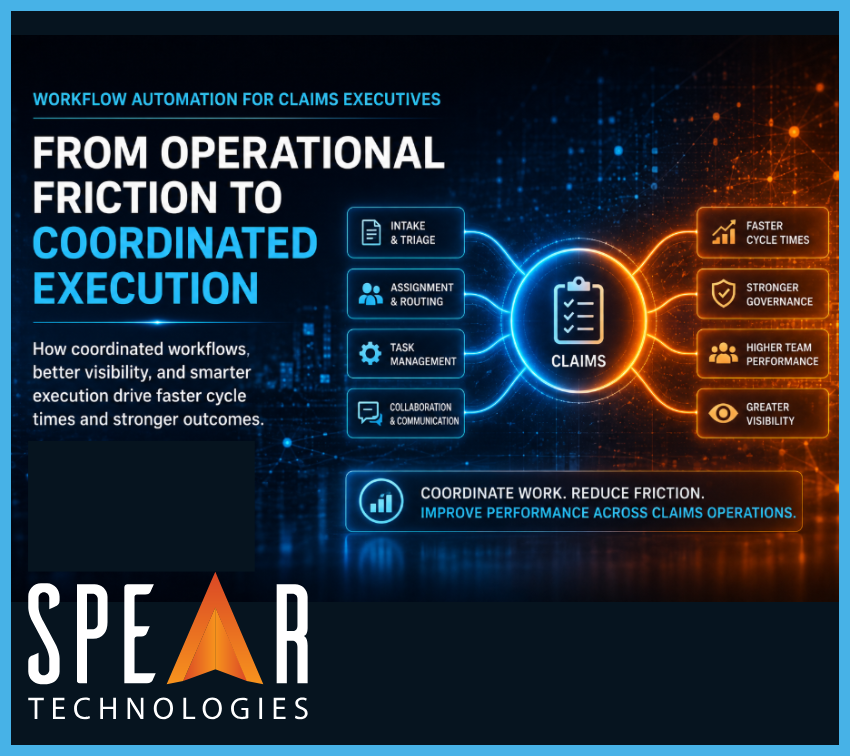
Operational complexity is increasing faster than most teams can add headcount. Many property and casualty organizations are not constrained by lack of effort. They are constrained by fragmented processes, disconnected systems, and limited operational coordination. For claims leaders, those issues often appear in the form of manual triage, status chasing, inconsistent workflows.
As expectations increase across the enterprise, leaders responsible for claim cycle time, loss cost control, adjuster productivity need more than workflow improvements at the department level. They need a more coordinated operating model that improves execution, strengthens visibility, and supports better decisions across the business.
Why the Traditional Model No Longer Scales
Many insurers still manage critical work through a mix of legacy systems, manual review, email-based handoffs, and disconnected reporting. Over time, that model creates structural friction:
- Slower cycle times and more status chasing
- Uneven execution across teams and regions
- Limited visibility into bottlenecks, leakage, and workload trends
- Difficulty scaling best practices across the organization
Even when individual teams perform well, the broader operating model remains harder to govern and slower to adapt. For claims leaders, that directly affects outcomes such as faster resolution, lower leakage, better team performance.
What Workflow Automation Changes
The value of a modern workflow automation platform is not simply that it automates tasks. Its value comes from how it coordinates work, applies business rules more consistently, and gives leadership better visibility into execution.
In practice, that often includes:
- Configurable routing, tasking, and approvals that reduce manual handoffs
- Rules-driven workflows that improve consistency across teams and regions
- Dashboards that expose cycle times, bottlenecks, and aging in real time
- Audit-ready activity tracking for stronger governance
Why This Matters to Claims Executives
For claims leaders, the strategic question is not whether more automation is possible. The question is whether the organization can operate with more discipline, speed, and consistency as volumes, compliance pressure, and service expectations continue to rise.
When the right capabilities are embedded into everyday workflows, leadership teams are better positioned to:
- Reduce manual effort in high-volume workflows
- Improve governance and auditability
- Give managers real-time visibility into performance
- Support better collaboration across operations, finance, and service teams
- Create a foundation for future analytics and automation
A Practical Path Forward
Most organizations do not begin with enterprise-wide transformation. They begin where operational friction is most visible and where stronger coordination can produce measurable business impact.
For claims leaders, that often means identifying the process where delays, inconsistency, or manual intervention are creating the most drag. Once that workflow is standardized and better instrumented, the organization is in a stronger position to expand into adjacent processes and build a more scalable operating foundation.
Final Thought
Property and casualty organizations do not need more disconnected tools layered onto already fragmented operations. They need platforms that help teams coordinate work more effectively, govern processes more confidently, and modernize execution without losing control. For claims leaders, that is what turns technology investment into meaningful operational performance.
Schedule a demo of SpearClaims™ to see how workflow automation and coordinated execution can help your organization reduce operational friction, improve visibility across claims processes, and support more consistent, disciplined performance across the enterprise.