
Measuring AI Success in Insurance: KPIs That Matter Beyond Cost Reduction
Artificial intelligence is rapidly becoming embedded across the insurance value chain. From claims and underwriting to customer service and fraud detection, AI is helping insurers operate faster and at greater scale.
For many organizations, however, the conversation around AI success remains narrowly focused on cost reduction.
While efficiency gains are important, they represent only a fraction of AI’s true value.
For CFOs and COOs, the more strategic question is this:
How do we measure AI in terms of operational performance, decision quality, and business impact?
Understanding the right KPIs is essential to realizing meaningful insurance AI ROI and ensuring that AI investments translate into measurable enterprise value.
Why Cost Reduction Is an Incomplete Measure of AI ROI
Cost savings are often the most immediate and visible outcome of AI adoption. Automation can reduce manual effort, shorten cycle times, and lower operational expenses.
However, focusing exclusively on cost creates two risks:
- It undervalues AI’s ability to improve decision quality
- It limits investment in higher-impact use cases
In many cases, the greatest value of AI comes not from doing the same work cheaper, but from doing better work altogether.
For example:
- More accurate underwriting improves loss ratios
- Faster claims resolution increases customer retention
- Better fraud detection reduces leakage
These outcomes directly impact revenue, profitability, and competitive positioning.
To capture this broader value, insurers need a more comprehensive approach to AI metrics.
The Core Categories of AI Metrics in Insurance
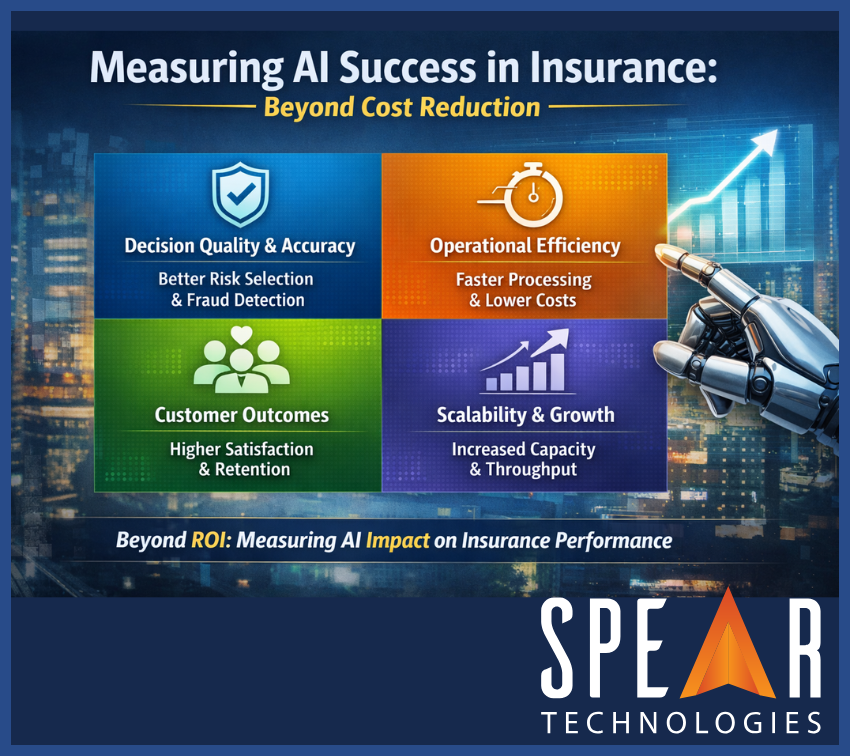
To properly measure AI success, insurers should evaluate performance across four key dimensions.
1. Operational Efficiency Metrics
These are the most commonly tracked KPIs and remain important, particularly for CFO visibility.
Examples include:
- Claims cycle time reduction
- Underwriting turnaround time
- Cost per claim or policy
- Adjuster productivity
While these metrics demonstrate efficiency gains, they should be viewed as baseline indicators, not the full picture of AI ROI.
2. Decision Quality and Accuracy
AI’s ability to improve decision making is one of its most valuable contributions.
Key metrics include:
- Loss ratio improvement
- Claim severity accuracy
- Fraud detection precision and recall
- Underwriting risk selection accuracy
These metrics are critical because they directly influence financial performance. Even small improvements can translate into significant bottom-line impact.
For executive leadership, this is where AI begins to shift from a cost lever to a profitability driver.
3. Throughput and Scalability
AI enables insurers to handle higher volumes of work without proportional increases in headcount.
Relevant KPIs include:
- Claims processed per adjuster
- Policies underwritten per underwriter
- Straight-through processing rates
- Volume handled without additional staffing
This category is particularly important for COOs focused on operational scalability and growth.
AI allows organizations to expand capacity while maintaining consistency and control.
4. Customer and Policyholder Outcomes
AI’s impact on customer experience is often overlooked in ROI calculations, but it is increasingly important.
Metrics to track include:
- Time to first notice of loss (FNOL) to resolution
- Customer satisfaction (CSAT) and Net Promoter Score (NPS)
- Retention and renewal rates
- Complaint frequency
Improved customer outcomes not only strengthen brand reputation but also drive long-term revenue stability.
For many insurers, this is where AI creates a meaningful competitive advantage.
Moving from Activity Metrics to Outcome Metrics
One of the most common mistakes insurers make is focusing on activity-based metrics rather than outcome-based metrics.
For example:
- Number of automated decisions (activity)
- Versus improvement in loss ratio (outcome)
- Number of claims processed (activity)
- Versus reduction in claim leakage (outcome)
Executives should prioritize metrics that reflect business impact, not just system usage.
This shift is essential for demonstrating true insurance AI ROI at the board level.
The Role of Orchestration in Measuring AI Effectiveness
Measuring AI performance becomes significantly more complex when models operate across disconnected systems and workflows.
Without a unified structure, it is difficult to:
- Track how decisions are made
- Attribute outcomes to specific models
- Maintain consistent measurement across departments
This is where orchestration plays a critical role.
By embedding AI within structured workflows, orchestration enables insurers to:
- Capture end-to-end decision data
- Align KPIs across claims, underwriting, and service operations
- Maintain consistent measurement frameworks
- Improve visibility into AI-driven outcomes
For CFOs and COOs, this creates a clearer line of sight between AI investment and business performance.
Linking AI Metrics to Financial Outcomes
To fully justify AI investments, insurers must connect operational KPIs to financial results.
Examples include:
- Faster claims processing → Lower expense ratio
- Improved underwriting accuracy → Better combined ratio
- Reduced fraud → Direct cost savings
- Higher retention → Increased lifetime customer value
This linkage is critical for executive alignment.
AI should not be measured as a standalone technology initiative, but as a core driver of financial and operational performance.
Why AI Measurement Is Becoming a Strategic Priority
As AI adoption matures, insurers are moving beyond experimentation into enterprise-wide deployment.
At this stage, leadership teams expect:
- Clear ROI justification
- Consistent performance measurement
- Alignment with business objectives
This is particularly important in an environment where:
- Margins are under pressure
- Customer expectations are rising
- Regulatory scrutiny is increasing
Organizations that cannot clearly measure AI impact risk underinvesting in high-value opportunities or overinvesting in low-impact use cases.
The Path Forward: A More Complete View of AI ROI
AI success in insurance should not be defined by cost reduction alone.
A more complete framework includes:
- Efficiency gains
- Decision quality improvements
- Scalability and throughput
- Customer outcomes
- Financial impact
For CFOs and COOs, this broader perspective enables better investment decisions, stronger operational control, and clearer accountability.
Ultimately, the goal is not just to deploy AI, but to ensure it delivers measurable and sustained business value.
Intelligent Orchestration and Measurable AI Outcomes
Spear Technologies delivers Accessible AI designed to help insurers move beyond fragmented metrics and toward a unified view of AI performance.
Through SpearPolicy™ and SpearClaims™, insurers can implement orchestrated workflows that capture decision data, align KPIs across functions, and provide clear visibility into operational and financial outcomes.
By coordinating predictive, generative, and agentic AI within structured processes, organizations gain the ability to measure what truly matters:
- Improved decision quality
- Increased operational throughput
- Stronger financial performance
- Better customer outcomes
For insurers evaluating how to define and measure AI success in 2026 and beyond, the focus should shift from isolated efficiency gains to holistic, outcome-driven performance metrics.
This is where AI moves from experimentation to enterprise value.
Schedule a demo of SpearPolicy™ and SpearClaims™ to see how orchestrated AI can help your organization improve decision making, strengthen compliance oversight, and maintain control as AI adoption across the insurance industry continues to expand.